Literary Indigestion
H.P. Lovecraft + Michel Houellebecq + Stephen King

By “literary indigestion” I mean a mixture of immiscible parts. Styles, voices, purposes, paces—anything that’s made of incompatible parts. The relation between the elements might be dissonant, as in Naked Lunch, B.S. Johnson’s The Unfortunates, or Derrida’s Glas, where unrelated or incompatible texts are deliberately juxtaposed. Or it might be surprising to see different sorts of texts and images thrown together, as in maximalist fiction, Oulipo, and collage fiction, from Perec to Gaddis and Wallace.
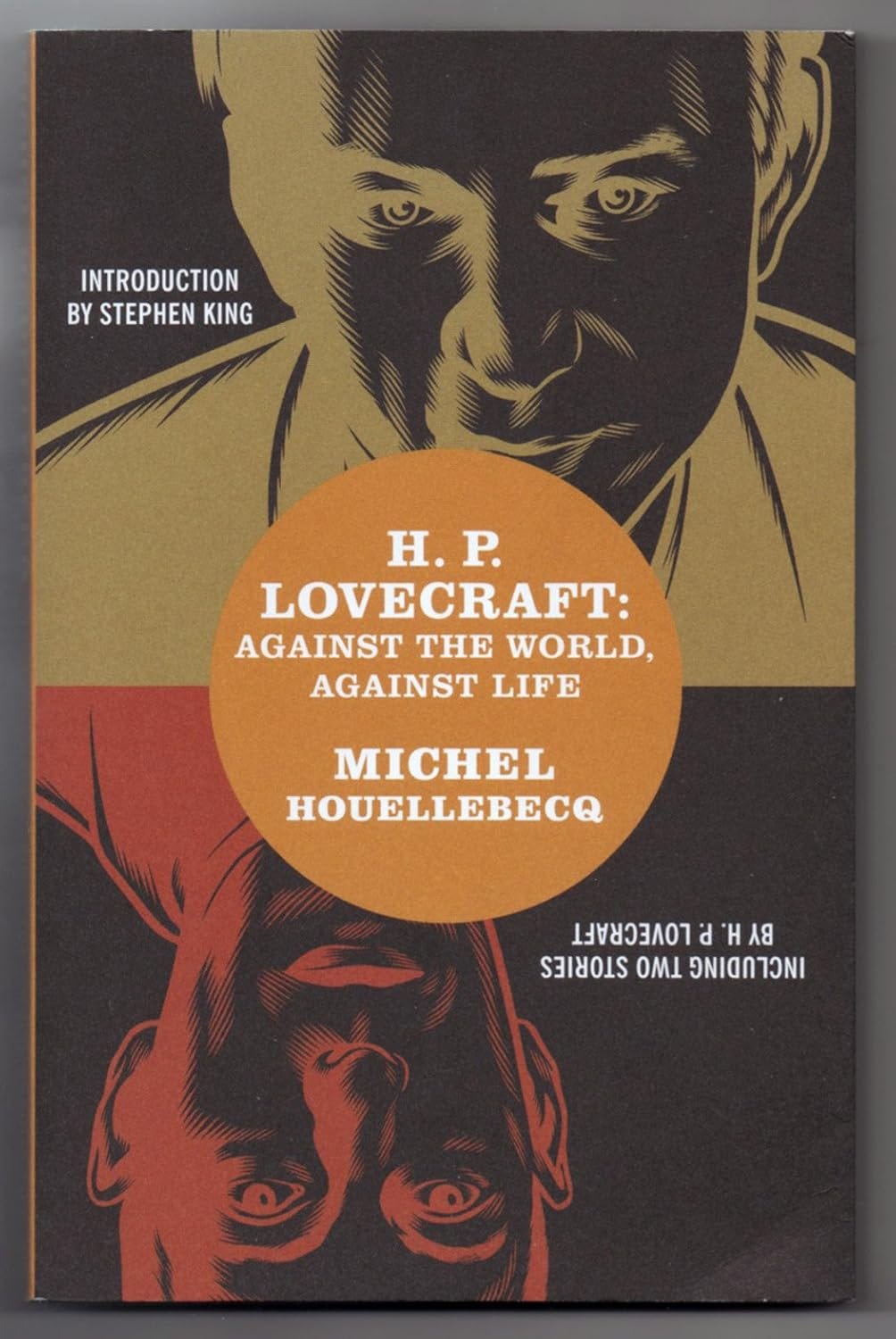
Michel Houellebecq’s H.P. Lovecraft: Against the World, Against Life, which has an introduction by Stephen King, isn’t indigestible in those interesting senses, where the implied author or narrator is intending readers to wonder about the text’s coherence. It’s indigestible because the three people involved—the young Houellebecq, his idol Lovecraft, and the elder statesman King—are so different.
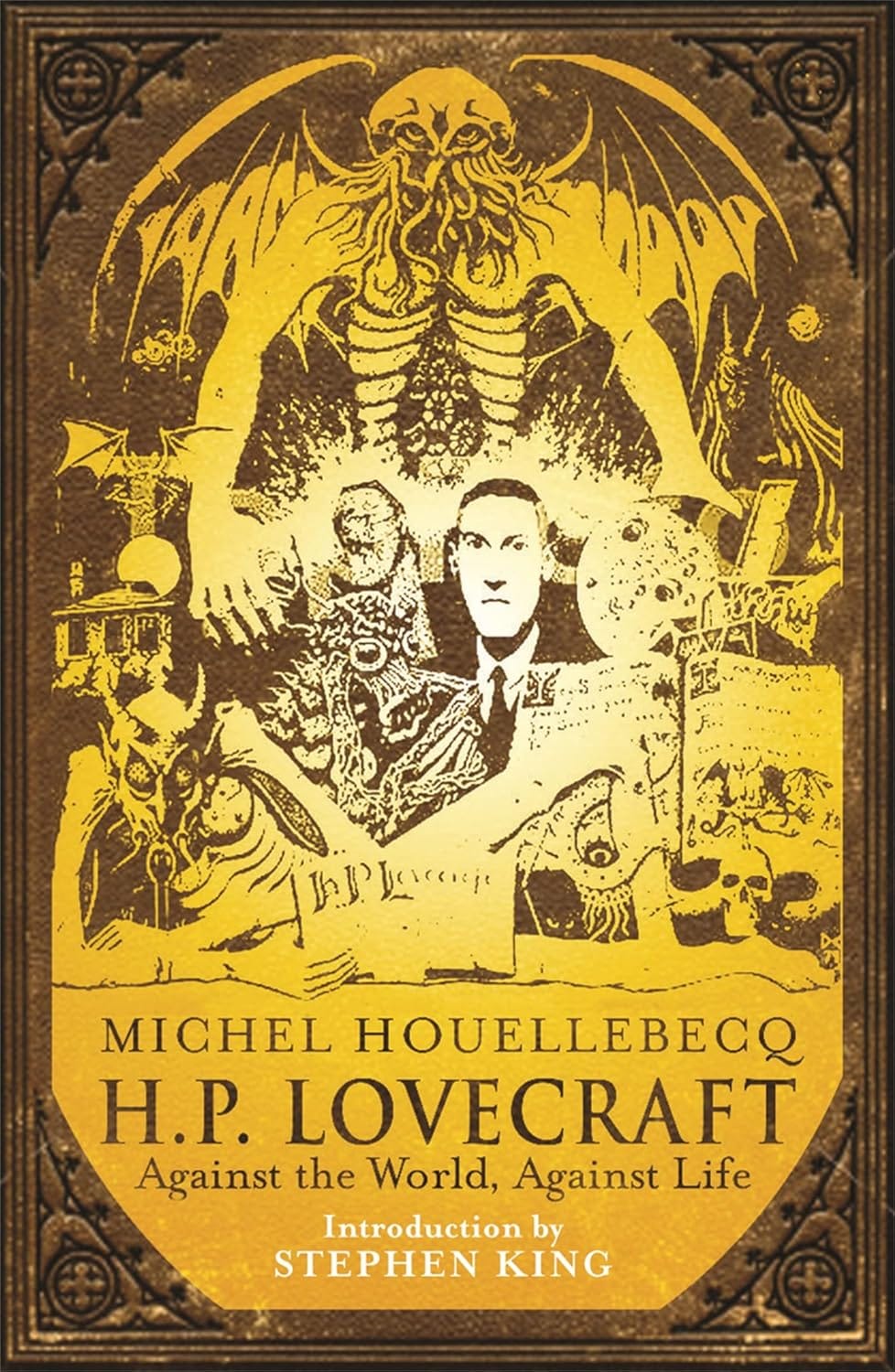
Lovecraft: for me, he is a rum writer. His prose is both ornate and viscous. It can look like perfumed glue. He seldom wrote parsimoniously. In order to wrench the weird from the ordinary he seems to have felt he needed to use every romantic and orientalist trope ever invented. His stories and books are full of entangled grotesqueries, abyssal horrors, sinister maelstroms of time, polyphonic histrionics, portentous mumblings, poisoned landscapes, hyperboles of wailing despair, and the whole lexicon of nineteenth-century bathos, each one inflated to bursting. Like Poe as Mister Creosote. From Lovecraft’s point of view, Poe must have seemed so spare and anemic that he was nearly invisible, fragile like the unfortunate character in “The Man Who Was Used Up.”
Houellebecq: I haven’t ever been his imagined reader. People who are offended or shocked by him are too easily upset (too bourgeois, too similar to his imagined targets), and people who are thrilled or challenged by him need to read Celine instead. In this text he worships Lovecraft for his supposed “hatred” of “the world” and “life,” and forgives him for his racism (naturally) and lack of interest in sex and politics (more surprisingly). Houellebecq says Lovecraft’s phobias make him “ever more present, ever more alive.” It’s a passionate essay, but also an opportunistic one, because Houellebecq wants to announce his devotion to someone who is widely disparaged, who had “great passion” (which nevertheless “one may deplore”), who hated humanity and the world, who wanted to warn everyone of the disaster (“evil”) lurking everywhere—a person who was, however, unlike Houellebecq himself in almost every way.
King: I haven’t been a fan since I was fifteen. Like everyone else on Earth I’ve read his books, and when I was young, I even read one or two out loud. For me the admixture of familiar North American life doesn’t increase the horror. His books are like letters written with a flare-tip marker: they can be full of color, but if they’re left out, a year later they are bleached back to the blank paper. In this book King is especially unappealing, because he opts for a patrician tone: he’s not passionate about either of his subjects, and he seems mainly interested in demonstrating a calm and benevolent detachment. He defangs Houellebecq, diplomatically bypassing his many obscenities and provocations, and he normalizes Lovecraft, painting him as an exemplary but typical early twentieth-century writer of “weird fiction.”
Of the three, Lovecraft wins: he’s genuinely strange, and often repulsive. His racism, which Houellebecq emphasizes and King ignores, is spectacularly unreflective and offensive. His brief sexual history is very odd. When I read Lovecraft, it’s for the queasy mixture of late Symbolism or decadent (fin-de-siècle) prose, baked-in racism, and occluded sexuality.
Second is Houellebecq, who went on to write novels intended to shock, and appears more interesting than I had anticipated here because of the transparence of his need to attach himself to the least likely and most culturally distant model of transgression in order to underwrite his future misbehavior. He was at an especially interesting point in his career when he wrote this, in need of a foil to support a practice he hoped would be pure transgression, as ferocious as Sade.
That would put King last: if you’d never read anything of his besides the essay in this book, you’d think of him as a senior writer like Bellow or Updike, asked to write a pleasant lecture for an association of retired academics—or like a retired publisher, with no stake in the subject except being acknowledged as an authority. That’s indigestion.
It’s interesting that indigestion is even possible in 2025, fully one-quarter of the way into the 21st century, when postmodernism has been around for sixty years. It seems everything that can be mashed-up has been—Pride and Prejudice and Zombies, fan art mixing Disney characters with H.R. Giger, Hello Kitty drawn by Junji Ito. In our current cultural condition, it might seem that nothing would be able to stir up a case of aesthetic nausea, but for me this book manages it.
Thank you for making me laugh while also making me wince, reading this dazzlingly incisive piece! Your take on literary indigestion as something more than just formal dissonance, as something existentially misaligned, a kind of psycho-textual reflux, is both elegant and discomforting. I’d add that true literary indigestion comes from aesthetic clash, but also from a deeper ontological mismatch, when authors don’t share a worldview, but are forced into communion by commercial packaging, the result can be not just jarring but absurd. Like hosting a séance where the ghosts summoned speak different languages and have no interest in each other.
Houellebecq genuflecting before Lovecraft is a kind of necrophilic cosplay, he’s seeking borrowed gravitas from a corpse whose values he neither shares nor understands, but whose shock value he finds reusable. As you say, it’s opportunistic, and transparent in its effort to legitimise his future provocations under the guise of literary lineage. This strikes me as less homage, more necromantic branding.
And King, yes, the flare-tip marker analogy is brilliant. He has become the Barnes & Noble of horror: familiar, comforting, a little dusty. Here, his patrician calm feels like a retiree curating a haunted house for schoolchildren: sanitised, brightly lit, and with all the sharp corners covered in foam.
I have some personal examples of literary indigestion:
- Norman Mailer’s “Ancient Evenings”: a grotesque hybrid of faux-Egyptology, stream-of-consciousness mysticism, and overwrought sexuality, like Joyce trying to ghostwrite “The Mummy” while high on mescaline.
- William S. Burroughs’ “The Ticket That Exploded”: less novel, more randomised transmission from a broken alien radio, its cut-up method veers past dissonance into chaos.
- John Fowles’ “The Magus”: a metafictional fever dream whose psychological, mystical, and erotic tones trip over each other in search of resolution that never comes. A masterpiece and a mess, depending on the page.
- Kathy Acker’s “Blood and Guts in High School”: exhilaratingly incoherent, like someone wrote Lolita on acid, using ransom-note clippings and a bad memory of Sophocles.
Your final point about how we have grown immune to aesthetic nausea is sharp. We live in the era of cultural bulimia…. everything is consumed, regurgitated, repackaged, digested again. But indigestion still happens, not despite this cultural saturation, but because of it. When all combinations are theoretically permissible, the truly indigestible emerges not from novelty, but from sincerity — when a text is out of joint because its parts are trying to play different games under the same title, not because it’s avant-garde.
In that sense, “H.P. Lovecraft: Against the World, Against Life” isn’t postmodern…… it’s post-mortem! And the autopsy was deeply unpleasant.